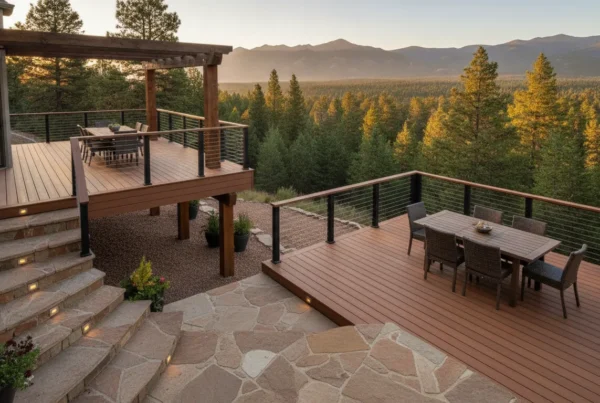
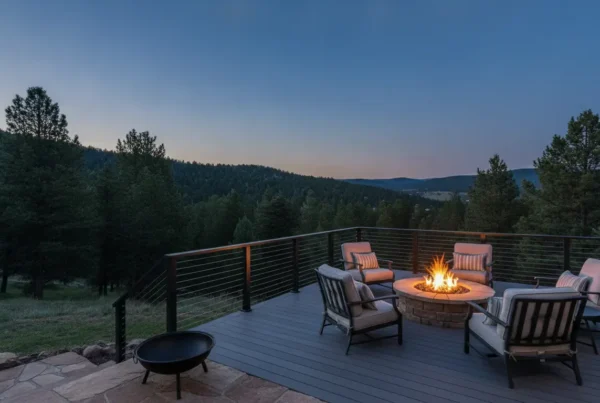
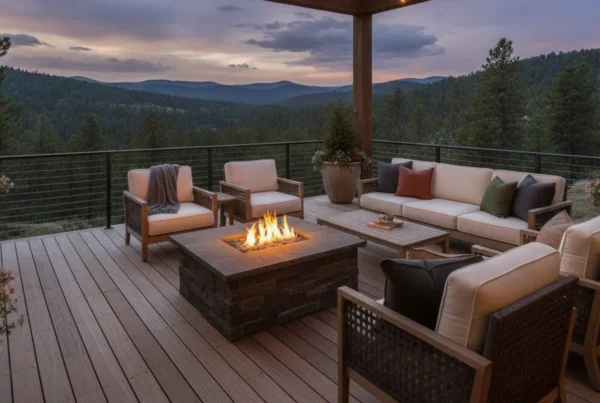
Good fire pit ideas start with the evening you want, not a catalog photo. A small deck needs a different gathering shape than a patio beside the kitchen, and a covered outdoor room is different again from a larger yard built for a crowd. Colorado Custom Covers & Decks designs those features as part of a new deck or a complete rebuild. The flame, the seats, and the path around them belong to one plan.
A portable bowl can be a short-term stand-in. It is not the same decision as a built feature that has to live with wind, snow, and the rest of the outdoor room.
Get a free estimate or call (720) 844-2156.
The ideas below are concepts for four kinds of space. Each one covers seating, how people walk, fuel, and wind. Site rules still change by parcel. A deck railing code question has to be answered for the actual property, not from a statewide guess. A concept that looks right in Morrison may need a different setback in Evergreen, Genesee, or an unincorporated lot. Treat these as planning pictures, then confirm the real limits before anyone builds.
What fire pit ideas should solve first
A fire pit idea fails when it only answers where the flame goes. The useful question is who sits, what they do while they are there, and what has to stay clear of the flame. A conversation circle wants faces turned inward. A dining edge wants plates and elbows outside the heat. A covered room wants the flame where smoke and heat will not collect under the roof. A larger party wants a second place to stand so the seats are not the only destination.
Four checks belong on every concept before you fall in love with a shape.
- Seating distance. People should feel the fire without sitting inside the heat or the required clear space.
- A walking path. It stays open when chairs are pulled out.
- Fuel. That means a wood fire you can tend, or a gas line planned from the meter.
- Wind. Note where smoke will travel on a typical foothills evening.
Colorado Custom Covers & Decks does not treat a fire feature as a guaranteed add-on you can drop onto any existing deck. Lighting, railings, kitchens, and fire features are planned with a larger build unless the scope is confirmed. The free consultation and the detailed estimate carry no obligation. Design, three-dimensional plans, and engineering review come after you accept that estimate.
Fire pit ideas for a deck conversation circle
On a deck, the strongest idea is usually a low circle or square. It should face the view and still leave the rail open. Guests sit across from each other, not in a row staring at the house. The pit sits far enough from the rail that a chair can slide back without hitting it, and far enough from the door that the path into the house stays clear.
A deck changes the idea in ways a yard photo will not show. The surface has to carry the feature, the people, and the snow that collects around it. A wood-burning pit also brings ash, embers, and a surface that must stay noncombustible under and around the flame. If the only flat area is tight against the house or under a wood eave, that is a reason to move the concept, not to squeeze the clearance.
Wind on a foothills deck often comes across the slope, not from the direction a calm photo suggests. Sit in the proposed chairs on a breezy evening before you lock the layout. If smoke hits the main seat or the door, rotate the circle or shift the pit toward the downwind edge of the deck. A deck railing can block a view of the flame if the pit is too low and the rail is too close. The concept should show both the seated eye line and the standing path.
Built-in benches look tidy, but they freeze the count. Four fixed seats are wrong if the household usually gathers six. Loose chairs around a defined edge let you add a seat for one night and put it away. Keep a hose or extinguisher reachable without crossing the seating.
Fire pit ideas for a patio beside the house
A patio idea works best as a pause between the house and the yard. It should not become a second room that blocks the door. One reliable layout puts the pit off the main walk, with dining or lounge seating on the house side and open yard on the other. People can step out, sit, and still reach the kitchen without threading between hot chairs.
Stone, concrete, and paver patios are part of a larger outdoor plan here, not a standalone hardscape job. If the patio does not exist yet, draw the pit and the paving together. A ring dropped onto an old slab often lands on the only path from the slider to the yard. Give that path its own width, then place seats outside it.
Fuel changes this idea more than the stone color does. A wood fire needs room to tend the flame and a place for dry wood that is not under the eave. It also needs a surface that can take ash. A gas fire pit is planned with a gas line run from the meter to the burner location.
Colorado Custom Covers & Decks does not sell or install propane fire pits. The usual built feature is not a tank hidden in the patio. Say where the line has to travel before you fall in love with a corner the meter cannot reach cleanly.
Wind at the house face can push smoke into the door or along a bedroom window. If that happens in the evening you actually use, the pretty corner by the slider is the wrong corner. Shift the pit downwind of the openings, and keep seating out of the smoke lane. The planning sequence for a Colorado fire pit covers the parcel, the site, and the fuel choice in more depth than a layout sketch can.
Fire pit ideas for a covered outdoor room
A covered porch, patio cover, or pergola changes the idea. The flame sits inside a room that already has a roof, not in the open yard. Heat and smoke need a way out. A wood fire under a low cover is often the wrong concept, even when the photo looks cozy.
A gas burner, still fed by a line from the meter, is easier to place in a covered room because you can shut it off without managing embers. The cover, the height, and the open sides still have to be designed for that burner. Do not assume a roof makes the fire safer.
Seating in a covered room should leave a clear walk from the house door to the yard door. A pit in the geometric center looks balanced on a drawing and blocks both trips. Put the flame to one side, with a sofa or two chairs facing it and the circulation running along the other side.
If the cover is a pergola with open slats, smoke can leave upward, though wind can also drop rain and snow onto the seating. A solid patio cover holds weather off the chairs and holds heat in, so the flame location and the open sides matter more.
Lighting belongs in the same concept. A fire is a poor reading light, and a single overhead fixture kills the mood. Low path light at the steps and a dim source at the seating let people move after dark without turning the room into a garage. Deck lighting planned with the build is the clean way to get that, rather than a cord across the walking path.
Snow changes covered-room ideas on foothills lots. A roof that dumps snow onto the only seat, or a pit placed where a drift stacks against the burner, will not match the summer photo. Walk the spot after a storm if you can. Note where the pile lands, and keep the flame and the main chair out of that zone.
Fire pit ideas for a larger entertaining space
A larger yard can hold more than one idea. It should not hold two fires fighting for the same seats. Pick a primary gathering pit, then give cooking and extra guests their own zones. The fire is the linger spot. The grill or outdoor kitchen is the work spot. The path between them should not cross the front of the flame.
A useful large-yard concept has three beats.
- Arrive from the house on a clear walk that does not pass through the seating.
- Pause at the fire, with enough chairs for the usual group and standing room behind them.
- Step to the kitchen or bar without carrying plates across the pit.
An outdoor kitchen and a fire feature share gas planning when both are in the project. Run the thinking for the meter line once, with branches to the burner and the cooking equipment, instead of treating the pit as a later surprise. An outdoor bar can sit just outside the heat so people stand with a drink and still see the flame, without blocking the seated circle.
For a crowd, a long linear burner along one edge of the patio can beat a round pit in the middle. Guests line one side, the walk stays on the other, and you are not asking twenty people to orbit a single bowl. A round pit still wins when the group is small and conversation matters more than a party flow. Match the shape to the headcount you actually host, not the largest holiday you might throw.
Keep a second, flame-free seat for anyone who wants the company without the heat. That chair belongs in the same view, a few steps back, not in another corner of the yard. It also gives you a place to put a guest who should not sit near an open flame.
How seating and walking space change the idea
Most weak fire pit ideas are too tight. The flame looks generous, and the chairs have nowhere to go once people sit down. Leave room for knees toward the fire, room to push a chair back, and a path behind the chairs that a person can walk while holding a drink. If the path and the seats share one strip of paving, someone will trip on a pulled-out chair.
Built-in seating is a commitment. It looks finished, it stays put in the wind, and it is the wrong count the moment the household changes. Use it when the usual group is stable and you want the fire to read as architecture. Use movable chairs when the count swings. Either way, do not place a seat inside the clear space the fire needs, and do not face the main seat into the prevailing smoke.
Corners and level changes need their own thought. A pit at the turn of an L-shaped deck steals the only place people change direction. A pit on the low side of a step becomes a fall hazard after dark. Put the flame on a level run of deck or patio, with the step landing outside the seating. If the yard slopes, the better idea may be a short seat wall that takes up the grade, not a pit dug into the fall line where water wants to run.
Fuel, wind, and the limits of a portable pit
Every concept above still has to name a fuel. Wood gives a fire you tend, with smoke, ash, and ember risk, and it depends on whether that parcel allows a recreational fire at all. Gas gives a flame you can start and stop, which on these projects means a gas line from the meter to the fire pit, not a propane tank stored in the deck.
Colorado Custom Covers & Decks does not sell propane fire pits or do tank swaps. If a search led you toward a propane unit, the built answer is the metered line, planned before the layout is final.
Wind decides whether a beautiful idea is usable. Foothills gusts push smoke into the house, lift embers toward dry grass, and make a tall open flame hard to sit beside. A lower, broader flame in a sheltered spot usually beats a tall bowl on the windward edge. Screens and seat walls can calm a breeze. They can also trap smoke if they close the downwind side. Test the direction, then design the opening so smoke leaves away from faces and doors.
A portable fire pit is a flexible placeholder. You can move it for one party, store it, and learn where people actually want to sit. It does not solve a deck structure question, a gas line, or a cover. It still has to stay outdoors, on a suitable surface, and inside whatever distance your authority requires.
The 2024 International Fire Code, Section 307.4.3, sets a 15-foot distance from a structure for a listed portable outdoor fireplace used as the listing intends. A local amendment, a fire ban, or an HOA rule can be stricter. Confirm the rule for the parcel. Do not treat a model-code number as permission.
When the evenings you care about happen in the same spot, a built feature will fit the deck, the cover, and the seats better than a bowl you drag out of the garage. That is the point where a custom plan earns its place. Cost is a separate question, and the fire pit installation cost guide is the right next read if budget is what you are weighing. A fire pit table, with dining space around the flame, is its own layout and should be planned as a table rather than a round pit with a top added later.
Compare fire pit ideas before you choose one
Use the table to narrow the concept. It is a planning comparison, not a price list and not a promise that every idea fits every lot.
| Idea | Best for | Watch-outs |
|---|---|---|
| Deck conversation circle. | Small groups and a view. | Structure, rail clearance, and smoke toward the door. |
| Patio beside the house. | Easy trips to the kitchen. | Blocking the walk, and the gas-line path from the meter. |
| Covered outdoor room. | Shoulder-season evenings. | Heat under the roof, snow shedding, and open sides. |
| Linear burner for a crowd. | Larger parties and a clear walk. | Needs length, and a flame-free seat off to the side. |
| Round pit in a big yard. | Face-to-face conversation. | Steals the center if the path has to cross it. |
| Portable bowl. | Learning where you sit. | Not a deck, gas, or cover solution. It still has clearance rules. |
If two rows both fit, choose the one that matches the evenings you already have, not the party you might host once a year. A circle for four used every Friday beats a party layout that sits empty.
How a custom plan turns an idea into a build
Bring the concept you like when you request a free estimate. Tell the team how many people sit. Say whether you want wood or a gas line. Say whether a cover or kitchen is part of the same project. Colorado Custom Covers & Decks will look at the deck or the rebuild as a whole. The fire feature is drawn with the framing, the walking space, and the other outdoor pieces, not bolted on after the rail is already up.
The service area includes Morrison, Evergreen, Conifer, Genesee, Golden, Littleton, Lakewood, the foothills, and the wider Front Range. A published idea is not a promise that the same layout, the same timing, or a crew schedule exists in every town. Snow, slope, access, and the authority for that parcel change the work. Permits, when they apply, follow the jurisdiction of the property.
You can see how finished projects come together in the project portfolio, then talk through a version that fits your lot. Nothing in that conversation obligates you to build.
See custom fire pit and fireplace options, or call (720) 844-2156 to talk through a free estimate.
Frequently asked questions
What are good fire pit ideas for a small Colorado deck?
A low conversation circle, set off the door and clear of the rail, usually works better than a pit in the middle of the only walkway. Keep chairs out of the required clear space, and check where smoke blows before you commit. If the deck cannot carry a built feature, say so early. Do not force a heavy pit onto a structure that was not planned for it.
Can a fire pit idea include a cover or pergola?
Yes, if the cover is part of the design. A gas line from the meter is the usual fuel under a cover, because you can shut the flame off and you are not managing a wood fire’s embers. The roof height, the open sides, and where snow sheds still have to be designed around the burner. A cover is not a shortcut around clearance rules.
Do these fire pit ideas use propane?
No. Colorado Custom Covers & Decks does not sell or install propane fire pits. When a project includes a gas fire pit, the usual approach is a gas line run from the meter to the burner, planned with the deck or the full rebuild. A portable propane unit is a different product, and it is not the recommendation here.
Are fire pit ideas the same as a build plan?
No. An idea fixes the gathering shape: who sits, where they walk, and how the flame fits the deck, patio, or covered room. A build plan covers the parcel, the structure, the fuel, and whatever the local authority requires. Read the how-to planning guide for that sequence, and get a free estimate before you treat any concept as ready to build.
What should I do if I want a permanent fire feature?
Request a free estimate and bring the concept that matches how you entertain. Say whether you want it on a deck, a patio, or under a cover, and whether a kitchen or bar is part of the same project. Design drawings and engineering review come after you accept the estimate. The visit itself is free and has no obligation.