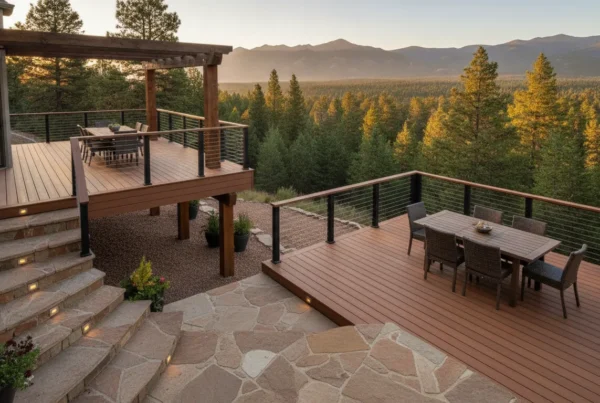
A deck can be a favorite spot for dinner and time with friends, so damage can leave you wondering how soon it needs attention. The answer is not always obvious. Worn boards can hide rot or movement in the supports. When you weigh deck replacement vs repair, look beneath the surface, not just at the boards. Common warning signs can show when a Colorado deck is no longer a surface problem. Keep people off a deck that shifts, sags, or pulls away from the house.
Get a free estimate for a new deck or a complete rebuild. You can also call (720) 301-5535.
Key Takeaways
- Check the structure first: Look past the boards to the ledger, framing, posts, and footings. If the deck shifts, sags, or feels unsafe, keep people off it.
- Limited damage is not a sound deck: A few worn boards can sit on a frame that still needs a rebuild. Widespread rot, movement, or a failing ledger points toward replacement.
- Compare a full rebuild, not a patch: Ask what a new deck includes, from framing and footings to stairs, railings, permits, and plans.
Should You Repair or Replace Your Deck?
The right choice depends on more than how the deck looks. Worn boards can sit on a sound frame, or on one that is not. Before you decide, look at the structure that carries the load.
Limited board damage still needs a structural look
A few cracked boards can look like a small job. That reading only holds if the posts, beams, ledger, and connections are still sound. New boards do not fix rot, loose hardware, or a frame that has started to move.
Age alone does not decide the outcome. Water, snow, sun, and the original build all change how a deck holds up. Soft spots or damage in several places call for an inspection before any surface work. Signs a Colorado deck needs replacement start with the main structure, not the boards you can see.
New boards only make sense on a sound frame
Replacing worn boards while keeping the frame can refresh the surface. It only makes sense when the framing, ledger, beams, posts, and footings are sound. Have those parts checked for rot, movement, and loose connections first.
New boards cannot correct weak framing or unstable supports. If the structure is solid, a surface refresh can address wear. If its condition is unclear, get an inspection before buying materials. When a Colorado deck should be replaced comes down to what is happening under the boards.
Replace when damage makes a patch unsafe
Replacement is the safer path when damage reaches several structural areas. Warning signs include shifting footings, rotted posts or beams, a failing ledger, or framing that cannot carry the deck. Fixing a few visible spots can leave those problems in place.
A qualified builder should look at the whole structure and say whether the frame can stay. Failed supports, shifted footings, and undersized framing are reasons to rebuild. For a new build, residential decking from Colorado Custom Covers & Decks covers custom design and construction.
Why the structure matters more than the surface
Deck boards are what you see. The frame, connections, and footings carry the load. Worn boards do not always mean the whole deck must go. New-looking boards can also hide rot or loose connections. Appearance alone cannot confirm that a deck is safe.
Pay close attention to the ledger, which ties the deck to the house, and to posts and footings that can shift. Sagging, movement, or a gap at the house needs prompt attention. If the deck moves or feels unstable, keep people off it until it has been assessed.
What Signs Show Your Deck Needs Repair or Replacement?
A deck can look worn while the frame is still sound, or look fine while hidden connections have weakened. Watch the boards, the supports, and how the deck feels underfoot. If anything seems unstable, keep people off it and ask a deck builder to assess it.
Check for cracked, loose, splintered, or soft boards
Look for cracked, lifting, splintered, or loose boards, plus soft spots and discoloration. Boards that stay damp are more open to rot, especially where water collects. A few damaged boards may be local. Softness across a wider area can mean moisture has reached the frame.
Do not cover a soft area with new boards or a coating before you know the cause. Isolated board damage and widespread rot are different problems. A builder can check whether the issue stops at the decking or continues into the frame.
Look for sagging, shifting, rot, or a gap at the house
From a safe spot, look along the edges and see whether the surface is still level. Sagging, movement, or rot around beams and posts can signal structural trouble. Check where the deck meets the house for gaps, pulling away, or decayed wood.
That connection is the ledger, and it helps hold the deck to the home. A visible gap is not something to close by tightening a few fasteners. The cause may be hidden. If the deck is shifting or pulling away, stop using it. Ledger failure is a serious safety concern, not a cosmetic flaw.
Inspect railings, stairs, posts, and connectors
Look over railings, stair treads, posts, and visible metal connectors. Watch for loose railings, cracked stair parts, rust, missing fasteners, or hardware that is backing out. Check post connections from a safe position.
A post that moves at its base may have a failed connection, not just a loose bolt. Do not lean on a shaky railing or step on stairs that look unstable to test them. Note what you can see and share it with a qualified builder.
Treat ledger damage or unstable supports as urgent
The ledger, beams, posts, and footings support the deck, so visible damage there needs prompt attention. Look for a ledger pulling away from the house, rot around fasteners, cracked posts, or footings that have shifted.
If you see any of these signs, keep people off the deck. Do not add heavy furniture or plan a gathering while you wait. Serious decay or a poor connection can create a collapse risk, and the boards can hide what is below.
Keep people off decks that move or feel unsafe
If a deck bounces, shifts, dips, or makes new creaking sounds, stop using it until a professional has checked it. Treat a moving railing, flexing stairs, or an unstable section the same way. Block access if you can do so safely.
Do not test a suspected problem by adding weight. From a safe position, take photos and note when you first noticed the change. Colorado Custom Covers & Decks designs and builds residential decks for a new deck or a complete rebuild.
How Can You Assess Your Deck?
Start with a visual check from a safe place. Look over the surface, stairs, and railings, then inspect visible framing from the ground if you can do so without climbing underneath. Take photos of damage, moisture, movement, or loose connections.
A visual check can spot warning signs. It cannot confirm that a deck is structurally sound. Do not test a questionable area by jumping on it or shaking a railing. If the deck sags, shifts, or pulls away from the house, keep people off it. A newer-looking surface may still sit on older framing.
- Photograph soft boards, gaps at the house, and rusty or missing hardware.
- Note the deck’s age, past work, and spots that stay damp.
- Stay off anything that moves, sags, or feels unstable.
- Share the photos with a deck builder before you buy new boards.
Note surface damage, soft spots, and areas that stay damp
Look for boards that are cracked, loose, splintered, discolored, or soft underfoot. Pay attention to spots that stay damp after nearby areas have dried, especially around planters, stairs, and leaf piles. Persistent moisture can feed wood decay.
A few damaged boards may be isolated. Damage in several areas can point to a broader issue below the surface. Note the location and take photos to share. Isolated rot and widespread moisture damage are different problems, and the surrounding deck helps show which one you are seeing.
Check visible framing, the ledger, beams, posts, and footings
From a safe vantage point, look for cracking, rot, sagging, or shifting in the framing, beams, posts, and footings. Pay particular attention to the ledger board, which connects the deck to the house. Gaps, dark streaks, or soft-looking wood near this connection need prompt attention.
Do not climb beneath the deck or move parts to get a closer look. If a support looks damaged, or the deck seems to be separating from the house, keep people off it. A damaged ledger is a serious safety concern, so do not treat damage at this connection as a cosmetic issue.
Look for rusted connectors and separated joints
Check visible joist hangers and brackets for rust, bending, or signs they have pulled away from the wood. Look for missing fasteners and joints that appear separated. You can note loose stairs or posts, but do not shake them to test them.
Hardware ties the structural pieces together, so damage can affect stability as well as appearance. A visual check can flag areas that need a closer look. It cannot prove that a connector is still strong enough to carry the deck.
Consider age, repair history, and Colorado weather exposure
A deck’s age is useful context, but it does not decide the condition by itself. If you can, find out when the deck was built, what work has been done, and whether the original framing is still in place. Newer boards may still rely on older joists, beams, or a ledger.
Note recurring issues, such as boards that keep softening or hardware that loosens. Colorado sun, snow, moisture, and temperature swings all affect an outdoor structure. If you are considering a larger update, ask Colorado Custom Covers & Decks about residential decking options.
Visual checks cannot rule out hidden damage
A deck can look sound from above while damage stays hidden in the framing, posts, footings, or connections. If you see soft wood, sagging, movement, or a gap near the house, do not assume the problem stops where you can see it.
Keep people off any part that feels unsafe, and get an assessment before new boards go over the old frame. Colorado Custom Covers & Decks plans and builds custom decks when the project calls for more than a surface change.
How Do You Choose Between Repair, Resurfacing, and Replacement?
The right option depends on the structure, how far the damage has spread, and how much useful life you can expect afterward. A surface refresh is enough only when the supports and framing are sound. Colorado Custom Covers & Decks builds new decks and complete rebuilds rather than patch repairs.
| What you see. | What it usually means. | Safer next step. |
|---|---|---|
| A few worn boards on a solid frame. | The problem may stop at the surface. | Have the frame checked first. |
| Soft spots or hardware that keeps loosening. | Moisture or movement may go past the boards. | Inspect before resurfacing. |
| Sagging, rot, or a failing ledger. | The structure itself may be unsafe. | Stay off the deck and plan a rebuild. |
Weigh the structure, the damage, and remaining life
Look past the boards. Check the ledger, beams, posts, footings, and the connection to the house. A few cracked boards may be a surface issue if the rest of the structure is sound. Widespread rot or shifting supports make replacement the safer choice.
Also think about how long each option is likely to serve you. A patch can solve one spot. Repeated fixes can add up without improving the deck as a whole.
Use age as context, not the only reason to replace
Age can inform the decision, but it does not tell the whole story. A well-kept deck may stay sound for years. A newer one can fail if water reaches the framing. Consider the original build, past work, and snow and moisture exposure.
Replacement deserves a hard look when several structural points have failed or footings have shifted. An older deck is not automatically unsafe. A newer deck is not automatically sound.
Compare a surface refresh with the deck’s condition
Ask for a written scope that separates surface work from structural work and from a full rebuild. Then compare each option with the deck’s condition and the life you can expect afterward. A lower upfront cost is weak value if aging frame parts stay in place.
There is no fixed share of a new-deck price that says when a patch stops making sense. The comparison depends on size, materials, access, and what the structure needs. Ask what each scope includes, such as permits, plans, stairs, and railings.
Consider safety, building rules, and daily use
Put safety first. A sagging deck, loose railing, shifting support, or gap at the house can point to a serious problem. If the deck moves or feels unstable, keep people off it and arrange an inspection.
Think about how you want to use the space. You may want wider stairs, a covered area, or room for outdoor dining. A patch usually keeps the old layout. A rebuild can let you rethink it. Colorado Custom Covers & Decks designs residential decks around that use.
New boards will not fix a failing frame
Resurfacing replaces worn boards and keeps the existing frame. It can fit when the framing, posts, and footings are sound. New boards will not fix rot, weak connections, or unstable footings. Covering those problems can leave the risk in place.
Before you choose a new surface, ask a builder to inspect the structure. Ask what was checked and what needs attention. Surface work cannot correct a weak frame. What to look for in a Colorado deck builder includes questions to ask before you hire.
How Do Repair and Replacement Costs Compare?
The lowest number is not always the least expensive choice over time. Compare what each option includes, how long it should last, and what care it will need. Prices are project-specific. Colorado Custom Covers & Decks does not publish a repair price or a percentage cutoff.
A limited fix depends on damage, access, and labor
The cost of limited work depends on the size of the damaged area, the materials, and how hard the spot is to reach. Replacing a few boards is a different scope from stairs, railings, framing, or the ledger.
Ask whether a written scope includes labor, materials, removal, and disposal, plus any structural work. Prices from another region are not a quote for a Colorado home. Ask which parts of your deck the work actually covers.
Replacement cost depends on size, design, and the site
Replacing a deck means removing the old structure and building a new one. The price depends on more than square footage. Layout, decking material, access, and slope can all change the work. Wider stairs, a cover, or space for an outdoor kitchen can change it too.
Before you compare prices, make sure each proposal uses the same design and materials. Online ranges are not a site-specific number. For an estimate based on your property, talk with Colorado Custom Covers & Decks about a new residential deck.
Include stairs, railings, permits, and plans
Check that each proposal covers the full scope, not only the deck boards. Stairs and railings may need to be rebuilt. Structural work can include joists, beams, posts, footings, or the ledger. Permits or engineered plans may be required.
Ask what is included, what may need approval, and which costs could change if hidden damage shows up. A written scope shows whether you are comparing similar projects.
Compare proposals, warranties, and expected care
Ask for itemized proposals that describe the same work. Each should list materials, labor, demolition, structural work, permits, and exclusions. Ask what warranties cover, how long they last, and what care the new deck will need.
A lower number may leave aging framing in place. Compare the details rather than the totals alone. New boards cannot extend the life of framing that is already failing. Signs it is time for a new deck come back to the structure, not the first price.
Repeated patches can make a rebuild the better value
When damage is limited and the frame is sound, a focused fix may extend the deck’s use. If several parts are failing, repeated patches can add up while older pieces stay in place. Ask what each fix solves and whether more work is likely soon.
Then compare that outlook with the cost and scope of a rebuild. The right choice still depends on the deck in front of you. Choosing a deck builder is part of getting a scope you can compare.
What Long-Term Trade-Offs Should You Consider?
A limited fix may not last.
When damage is limited to a few boards or a small section of railing, a targeted fix can restore use without replacing the whole deck. It only makes sense if the framing, posts, and footings are sound. Otherwise a surface fix can hide a more serious issue.
If problems keep returning, compare more patches with the condition of the structure. A short-term fix often costs less at the start and may add only a little life. Living with an old deck versus replacing it is easier to judge once you know the frame.
Resurfacing refreshes the look and leaves the frame
Resurfacing replaces the boards and keeps the existing frame. It can freshen a worn deck only when the framing, posts, beams, and footings are sound. New boards will not correct rot, shifting supports, or damaged joists.
Have the structure inspected first, especially if the deck feels soft, slopes, or has boards that keep loosening. Hidden damage can leave the main problem in place.
Replacement can fix the structure and open a new layout
Replacing a deck lets a builder assess the footings, framing, and connections, then plan around the site. It can also be a chance to rethink the layout, improve access, or add stairs, a cover, or room for outdoor dining.
A full replacement takes more planning than a small fix. It can address problems that surface work cannot. Permits or engineered plans may be needed. Talk through priorities early so the design matches how you use the space.
Compare wood and composite for care and weather
Wood has a natural look, and it typically needs regular cleaning and a protective finish. Composite decking generally needs less routine care and can resist splinters. Products differ, so read each maker’s care notes and warranty.
For a Colorado home, factor in sun, snow, moisture, and temperature swings. Ask how the specific products hold up in that exposure. Colorado Custom Covers & Decks builds with composite and other decking as part of a custom deck or a complete rebuild.
Factor in disruption, safety, and how long it should last
A small fix may take less time. It is a good choice only if it solves the real problem and leaves the deck safe. Replacement usually means more planning, and you may need to stay off the deck while work is underway.
Ask how the work affects access to the house and yard, and whether permits are included. If the deck moves, sags, or separates from the house, keep people off it until it has been assessed.
When Should You Call a Deck Professional?
A visual check can show worn boards or a loose railing. It cannot confirm that the ledger, framing, or footings are sound. If you see rot, shifting, or separation, get an inspection before you decide that new boards will solve it.
Ask for a written assessment that separates surface findings from structural ones, plus an itemized proposal. For a rebuild, ask whether the scope includes design, engineered plans, permits, and inspections. Request a free estimate from Colorado Custom Covers & Decks when you are ready to talk through a new deck or a complete rebuild.
Request an inspection for hidden structural damage
The ledger connects an attached deck to the home. The framing, posts, and footings carry the weight. Rot near the house, cracked posts, sagging beams, or separated joints can point to structural damage that a look from above can miss.
Ask a professional to check those parts and any place where moisture may have collected. Share past work and recurring issues. Ask which parts could not be inspected.
Call promptly if the deck sags, shifts, or pulls away
Movement underfoot, visible sagging, or a gap at the house can signal a structural problem. Loose posts and unstable stairs need attention too. Do not wait to see if it gets worse, and do not try a temporary fix on your own.
Keep people off the deck if it feels unstable. Describe where the movement is and whether it has changed. Treat ledger damage as a serious concern and stop using the deck if that connection looks like it is failing.
Ask for a written split between surface and structure
A useful assessment should say what was inspected, what was found, and what work is recommended. Ask the builder to separate worn boards from findings on the ledger, framing, posts, or footings. That split shows whether new boards would hide a deeper problem.
Request an itemized proposal that names materials, labor, and upgrades. If replacement is the path, ask how the design could fit the way you use the space. Compare recommendations on safety and scope, not looks alone.
Confirm permits, engineered plans, and building requirements
Before you approve work, ask who will check permit requirements and whether the project needs engineered plans. Rules vary by location and by scope. Replacing a few boards can be treated differently from changing structural parts.
Get the responsibilities in writing, including who handles applications, inspections, and plan changes. Some major structural changes can trigger a broader code review. Do not assume an older deck’s past approval decides what new work requires.
Get guidance before new boards if the frame is unclear
Resurfacing keeps much of the existing structure. It can be practical when the framing, posts, and footings are sound. New boards will not fix a weak frame. If you are unsure, get an inspection before you choose materials.
Ask whether the builder checked the ledger, joists, beams, posts, footings, and connectors. If the frame is still unclear, weigh a new surface against a rebuild. Colorado homeowners weighing a new deck should start with that structural question.
Plan a Deck That Is Safe to Use
If the ledger, framing, posts, or footings are in question, a patch will not give you a deck you can trust. Colorado Custom Covers & Decks designs and builds new custom decks and complete rebuilds for foothills homes. Get a free estimate and talk through a rebuild that fits the site. You can also call (720) 301-5535.
Frequently Asked Questions
Can I replace deck boards without rebuilding the entire deck?
Only if the framing, ledger, posts, beams, and footings are sound. Have the structure checked first. New boards will not correct damage underneath. If the frame is failing, a rebuild is the safer path.
How do I know if my deck is unsafe to use?
Movement, sagging, loose supports, or separation from the house can indicate a safety concern. Keep people off a deck that feels unstable and arrange a professional inspection.
Does an old deck always need to be replaced?
No. Age is one factor. Condition, past work, and weather exposure matter too. A professional can assess whether the structure is still sound.
What should a deck estimate include?
Ask for a written, itemized estimate that explains the work, materials, labor, and any structural scope. For a rebuild, confirm whether permits, engineered plans, inspections, and disposal are included.
Should I choose wood or composite for a replacement?
Compare the look, the care each material needs, the product warranty, and how it may perform on your site. Ask about specific products rather than a generic category.