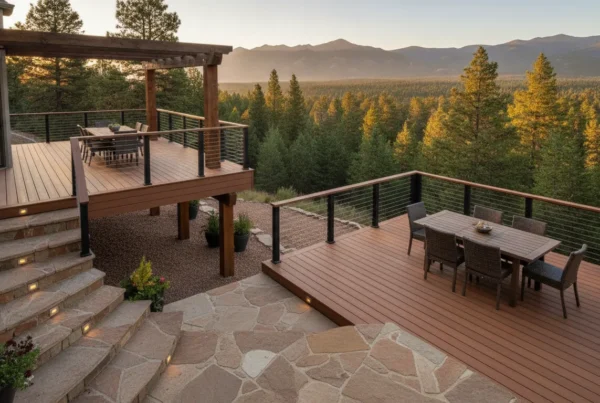
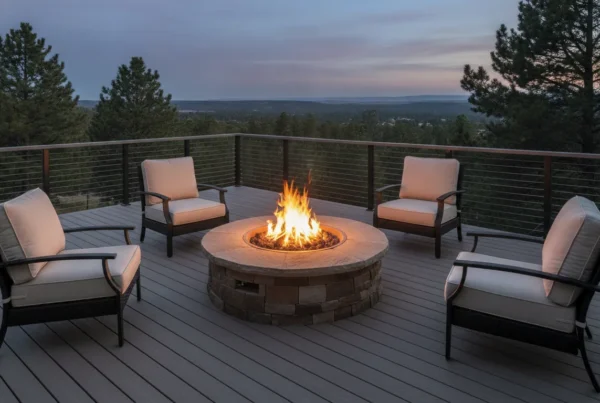
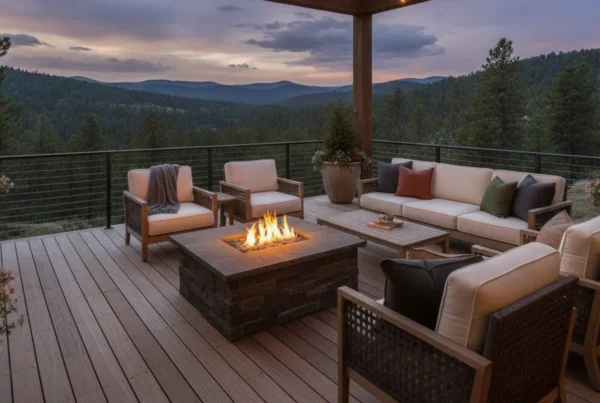
A portable fire pit is the unit you can lift, store, and set out for one evening. It is a fair way to test whether a flame belongs in the yard. It is a weak stand-in for a fire feature designed into a Colorado deck or patio. Storage, wind, and clearance show the difference. So does a bowl that was never drawn into the rest of the outdoor room.
Get a free estimate, or call (720) 844-2156.
This guide compares that movable unit with a built-in fire pit or fireplace on a custom outdoor project. It sits next to the broader look at outdoor living trends for Colorado homes. It is written for homeowners around Morrison, Evergreen, Conifer, Genesee, Golden, Littleton, Lakewood, and the wider Front Range. Colorado Custom Covers & Decks designs and builds new decks, complete rebuilds, and the outdoor rooms that go with them. A fire feature on those projects is part of the larger build. The consultation and the detailed estimate are free and carry no obligation. Design, three-dimensional plans, and engineering review come after you accept that estimate.
What a portable fire pit is good for
Search results for a portable fire pit are mostly camping bowls, smokeless rings, and patio units you can buy this weekend. Those products solve a real, narrow problem. You want a flame without opening the yard, pouring a pad, or waiting on a permit. You can try the idea before you commit a corner of the house to it.
That flexibility is the whole point. A listed portable outdoor fireplace can move with the season. Set it on a level, noncombustible surface for a cool evening, then put it away when the snow piles up or when guests need the patio for a table. If you rent, or if a deck rebuild is still a year away, a unit you can take with you can be the honest choice.
Flexibility has a ceiling. The unit still needs a flat, dry place, with real distance from the house, the cover, dry grass, and anything else that can burn. Foothills wind does not care that the bowl is small. A low spot fills with smoke, and a ridge throws embers farther than the product photo suggests. The National Fire Protection Association says to skip outdoor burning on windy, dry days, and to use a fire pit only outdoors on a level surface that will not catch fire.
Storage is the part catalogs skip. A steel bowl, a bag of wood, and a cover still need a home that is not the garage aisle you already trip over. Ash has to cool before it goes anywhere, and a cover left full of water becomes a rust pan by June. If the only storage is under a wood deck or against the siding, the easy unit has already created the hazard it was meant to avoid.
When a portable fire pit stops fitting the plan
A portable unit starts to fail when the evening is no longer a one-off. You are seating eight people rather than four, and you want the flame in the same place every Friday, beside the chairs, the path, and the light. You are tired of dragging a hot bowl off the composite and hunting for a spot the wind will allow. At that point the question is no longer which bowl to buy. It is whether the fire belongs in the outdoor room.
Watch for these signs:
- The only flat spot is against the house, under a wood eave, or inside the clearance your fire district expects.
- Guests keep moving chairs closer because the bowl is too small for the circle.
- Wind from the canyon or the open ridge ruins more evenings than it allows.
- You want the fire on a new deck, under a cover, or beside an outdoor kitchen, and the unit has no designed place to sit.
- You are about to rebuild the deck anyway, and a movable bowl would only be in the way of the new layout.
None of those signs means you failed by trying a portable unit first. They mean the next dollar belongs in the space, not in a second bowl. A custom deck or outdoor living project can put the fire where the clearances, the walking route, and the seating already agree.
Clearance, wind, and storage on a foothills lot
Rules are local. Unincorporated Jefferson County, a town, and a fire protection district can each have a say, and a rule written for one address does not travel to the next. Call the fire district that covers the house before you commit to a wood fire. Ask whether a burn restriction is in effect, and whether a contained recreational fire is allowed at all. Confirm the adopted fire code with that authority. Do not treat a model-code distance as permission to light a fire.
Section 307.4.3 of the 2021 International Fire Code is the model text people often quote for portable outdoor fireplaces. It says those units stay outside, get used as the listing intends, and stay at least 15 feet from a structure or combustible material. One listed exception still wants a noncombustible patio, that same 15-foot distance from a structure, and a spark screen over the opening. Your city or county may use that edition, an older one, the 2024 code, or its own amendments. The live guide to planning a Colorado fire pit walks those parcel questions in more detail, including size limits some local districts already publish for a recreational fire.
NFPA’s fire-pit guidance is simpler, and it is still strict. Use the pit outdoors only, at least 10 feet from anything that can burn, on a level surface such as patio blocks, brick, or concrete. Clear the trip hazards, and stay with the fire until it is out. A local 15-foot or 25-foot rule is stricter than that 10-foot tip, so the stricter number wins. The same advice bars plastics, construction debris, treated lumber, tires, pesticides, paint, and aerosol cans. Never start an outdoor fire with gasoline or another flammable liquid.
Wind is the foothills variable those national lines do not measure for you. A portable bowl has a short wall, so gusts push smoke into the seating and lift embers onto dry grass or wood mulch. A built-in feature can use a taller surround, a screen, and a spot chosen after someone stands on the lot during a normal afternoon wind. That is design work, not a product setting. If the lot sits in a wildfire hazard area, read the vegetation and the ember paths the same way you would for a deck in a wildfire hazard area. A pretty bowl set in juniper does not undo that risk.
Storage belongs in the same walk. Measure where the cold unit lives, where the dry wood lives, and where a hose or extinguisher can reach the flame without crossing the clearance. If those three spots only work by walking through the restricted area, the portable plan is already broken.
How a portable fire pit compares with a built-in feature
The useful comparison is not one brand against another. It is what each choice asks of the house. A portable unit asks for a clear pad and a storage spot you can live with. A built-in fire pit or fireplace asks for a designed place in a new deck, a rebuild, or a full outdoor room. The base, the fuel, and the seating get drawn together, instead of being solved one Saturday at a time.
| Question | Portable fire pit | Built-in fire feature |
|---|---|---|
| What it is good for | Trying a flame, small gatherings, and a unit you can store or take with you. | A permanent gathering place inside a deck, patio, or covered outdoor room. |
| Flexibility | High. You can move it when the wind shifts or the season changes. | Low, on purpose. The location is chosen once and built to stay. |
| Storage | You still store the unit, the fuel, and a dry cover. | No bowl to haul. Fuel storage, if any, is designed in. |
| Wind | Short walls and a light body lose to foothills gusts. | Height, screening, and placement can be matched to the lot. |
| Clearance | Still outdoors only. Model code often wants 15 feet from a structure, and the listing controls use. | Setbacks are designed into the layout, then confirmed with the authority for that parcel. |
| Deck or cover | A hot bowl on composite, under an eave, or on a wood deck is a layout problem. | Structure, ventilation, and walking room are part of the same drawings. |
| Fuel | Usually wood you bring to it. A portable propane tank is not a feature we install. | Wood in a rated firebox, or gas from a line run from the meter to the burner. |
| Next step | Use it as listed, or decide the yard has outgrown it. | A free estimate, then design after you accept that estimate. |
Price stays out of that table on purpose. A portable unit has a shelf price. A built-in feature is quoted for the specific lot, the structure, and the rest of the project. Dollar ranges published on other pages are examples, not a package and not a minimum. If you are pricing a permanent pit, use the estimate for that scope rather than a shopping cart.
Fuel: wood you carry, or gas from the meter
Fuel decides the feature more than the color of the stone. A portable fire pit is usually a wood fire you feed by hand. That brings the smell and the sound people picture, and it also brings smoke, ash, embers, and a fire you stay with until it is cold. On a dry, windy foothills evening, that can be the wrong fire even when the bowl is listed and the pad itself is legal.
Gas is the other path, and it is not a propane tank hidden in the deck. Colorado Custom Covers & Decks does not sell or install propane fire pits, portable propane units, or tank swaps. When a project includes a gas fire pit or a built-in grill, the usual path is a gas line run from the meter to that location. The line, a shutoff a guest can reach, and the air the burner needs are planned before the layout is frozen. A flexible kit draped across a finished deck is not that work.
Name the evenings you actually want. A wood fire a few times a year can stay on a portable unit, if the pad is legal and the storage is real. If you want a flame you can switch on beside the seating, without feeding smoke into a canyon wind, plan the gas feature with the deck. The fire pits and fireplaces page is the service overview for that permanent work. It is not a catalog of bowls to order for Saturday.
A fireplace is a third path. It is not a taller pit, and it is not a portable chimney. It has a firebox and a smoke path of its own. If that is the feature you keep describing, stop comparing bowls and look at fireplace planning instead. Asking a portable ring to act like a chimney wastes the evening and the budget.
How the fire fits a custom outdoor room
On a custom project, the fire is one piece of a room you will walk through after dark. The cover, the kitchen, the rail, and the path all have to respect the same clearances as the flame. A portable bowl dropped into the middle of that room blocks the route, sits under an eave, or lands where roof snow slides. A built-in feature is drawn with those edges already known.
Start from the project you are already considering. A new deck or a complete rebuild is the right moment to place the fire, because the framing, the level pad, and the walking surface are still open. Setting a bowl on a finished composite deck later usually means living with a clearance you can no longer move. If a cover is part of the same project, the flame also needs air and distance from the structure above it. A custom outdoor living plan is where those pieces share one layout, instead of arriving as three separate purchases.
Cooking is its own zone. A fire pit is a poor grill, and an outdoor kitchen wants its own clearances, a work surface, and utilities that are not borrowed from the fire ring. If both belong in the yard, give each one a real place in the plan. Seating follows the same rule. Chairs inside the ember zone, or set on a step lip that guests cannot see at night, turn a good flame into a bad room.
Put the decisions in this order:
- Call the fire district and the building authority for this parcel, and read any HOA rule that is stricter than both.
- Walk the wind, the slope, the dry vegetation, and the only level ground you actually have.
- Decide whether a listed portable unit can live there, storage included, or whether the fire has to be built in.
- If it will be built in, choose wood or a gas line from the meter before anyone picks a shape.
- Fold the feature into the deck or outdoor room, then request a detailed estimate. Design starts after you accept it.
That order keeps a weekend purchase from deciding a layout you will live with for years. It also keeps the permanent work inside a project that can carry the structure, the utilities, and the permit path.
What we will and will not build
Colorado Custom Covers & Decks is a Morrison-based design-build contractor for custom decks and outdoor living, for homes and for commercial properties. The fire work that fits is a custom fire pit, a fireplace, a fire table, or integrated seating, and it belongs inside a new build or a complete rebuild. Crews plan work across the foothills and the Front Range. That is not a promise of the same lead time, or of a finished project, in every town an article might name.
We do not sell the portable unit, size a propane tank, or tell you which camping bowl won a magazine test. We also do not treat a fire feature as a small add-on pulled off the deck, unless a specific scope says otherwise. If the honest answer is to keep the portable fire pit and use it exactly as listed, that is a sound outcome. The estimate is for the moment the yard needs a permanent place for the flame.
A few claims are easy to stretch, so they stay narrow here. Jonathan Moeller is a Deckorators Certified Elite contractor, and NADRA lists a category-and-year placement in each year from 2022 through 2025. Since 2016, 400-plus projects, and 15-plus years are company descriptions, not an audited ranking and not a promise that every job uses one decking brand. There is no walk-in showroom. The way in is the free estimate.
Request a free fire-feature estimate, or call (720) 844-2156.
Frequently asked questions
Is a portable fire pit allowed on a deck in Colorado?
Only this parcel can answer that. Many listings require the unit to stay outdoors, on a surface that will not burn, at the distance printed on the label. Model fire code often sets 15 feet from a structure for a portable outdoor fireplace, and your city, county, or fire district can require more. A wood or composite deck under a cover is a common place where both the listing and the local rule say no. Confirm the rule before you light anything.
Do you install portable propane fire pits?
No. We do not sell or install propane fire pits, portable propane units, or tank swaps. When a custom project needs a gas flame, we usually run a gas line from the meter to the fire pit or the grill. That line is planned with the deck or the outdoor room. It is not added later as a hose laid across the boards.
How is a portable fire pit different from a built-in one?
A portable fire pit moves, stores, and can leave with you. A built-in fire pit or fireplace stays put, with the base, the fuel, the seating, and the clearances designed into the project. The portable unit fits a trial, or a yard that cannot take a permanent feature yet. The built-in feature fits a space you are already building or rebuilding.
What should I check before I buy a portable unit?
Check the fire district, any burn restriction in effect today, the clearance on the listing, and a level surface that will not burn. Then check storage for the cold unit and the wood, a way to put the fire fully out, and whether the usual foothills wind will make that spot unusable. If those checks fail, a larger bowl will not repair them. NFPA’s outdoor-fire notes are the plain-language list. The district that covers your house is the binding one.
When should I ask for a built-in fire feature instead?
Ask when you want the flame in one place, beside seating you will use through the season, or when a new deck, a rebuild, or a covered outdoor room is already the plan. Bring the site limits with you to the conversation. The free estimate covers the project. Drawings and any engineering review come after you accept that estimate. A blog post cannot promise a start date. Snow, slope, access, and the jurisdiction all move the schedule.